
By Søren Kamper | Guest Contributor

Table of Contents
A good competitive game can make a room go quiet before everyone watching fully understands why. The score is close, one player is under pressure, and suddenly everyone leans forward. In football games, that reaction is easy to take for granted. A goal is a goal. A late equaliser needs very little translation.
That clarity is part of what makes EA Sports FC so easy to watch. When Sinza B14 finished the first Pamoja Esports League season as champions, the drama came from a structure the audience could follow: group tables, points, a knockout stage, an eight-game final and an MVP race. The league gave viewers something to understand before asking them to care.

That is not automatic in competitive games. Some of the most exciting multiplayer systems are surprisingly difficult to read from outside. Star Wars: Squadrons and Star Wars Battlefront II are useful examples from the much broader history of Star Wars games, because both create spectacular competitive moments, yet both reveal how much work a game must do before spectacle becomes understandable competition.
Spectators Need to Know What Matters
The first requirement is simple: the audience needs to know what winning looks like.
FC rarely has this problem. The pitch explains the geography, while the score and clock explain the situation. Even a viewer who does not understand every tactical detail can see why a late attack matters. That is also why a simple format such as the Kenya vs Tanzania money match between Collo Gamer and SahilM4 works so well. First to three wins. The rivalry has a shape before the first game starts.
Star Wars: Squadrons is more complicated, but Fleet Battles has a clean foundation. Two five-player teams fight through a tug-of-war. Gain momentum and your side attacks. Break through the enemy capital ships and the flagship becomes the final target. Lose control and the direction reverses.
The difficulty is that space is harder to read than a football pitch. There is no obvious halfway line. A pilot can turn vertically, drift behind a capital ship and reappear from a direction that makes perfect sense inside the cockpit and considerably less sense on a stream. The objective is readable. The movement is not always.
Roles Need to Be Visible
Competitive games become easier to watch when viewers can quickly identify what different players are trying to do.
Squadrons gives pilots fighters, interceptors, bombers and support ships. A bomber attacking a capital ship has a different job from an interceptor hunting pilots, while support ships can influence a push without delivering the dramatic final hit. For players, that creates teamwork. For spectators, those roles only help if the broadcast can make them visible.
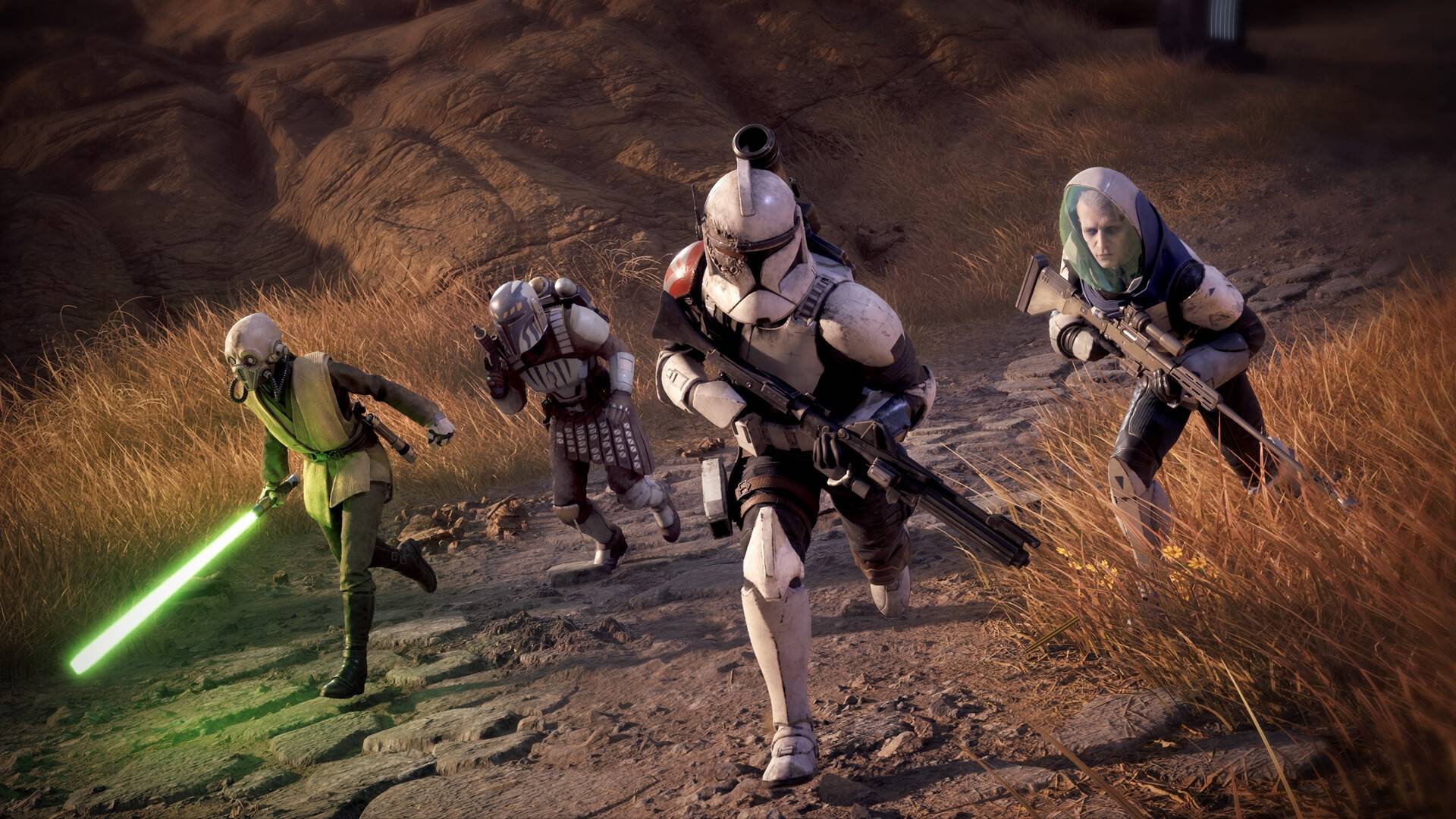
Battlefront II solves part of this more naturally. Assault, Heavy, Officer and Specialist troopers have distinct weapons and battlefield behaviour. A Heavy holding a corridor looks like someone holding a corridor. A Specialist firing from distance looks like a sniper. Then heroes, vehicles and reinforcements arrive and the game becomes wonderfully Star Wars, but also much noisier.
That trade-off matters. Spectacle attracts viewers. Too much spectacle can hide the match underneath it.
The same issue appears when tournaments move across different games. The second HelaBet e-Championship expanded from FC into eFootball and Call of Duty Mobile, with livestreaming part of the event. A football game and a mobile shooter do not explain themselves in the same visual language. Good broadcasting has to bridge that gap.

A Great Match Needs a Story Beyond the Match
The most readable esports are not only mechanically clear. They give the viewer a story that survives between games.
This is where leagues, rankings and rivalries become important. The FC 26 leaderboard places players inside a larger competitive picture. A tournament is no longer only about who wins today. Familiar names arrive with expectations attached to them.
That is what made the first Pamoja Esports League season more interesting than a collection of isolated results. Sinza B14 topped their group, reached the final and won the championship, while Hermes built an MVP campaign across the same season. By the final, viewers already knew what was at stake.
Squadrons had the ingredients for similar stories. Five-player teams are small enough for individual roles to matter, and Fleet Battles can swing between attack and defence. A team known for aggressive bombing runs or disciplined defensive flying could develop an identity spectators recognise before the match starts.
But games do not create those stories alone. Competitions do. A clear qualification path matters, as do standings, recurring teams, player profiles and a calendar where one result changes the meaning of the next. The FC 26 Esports Nations Cup qualification route is compelling partly because players and viewers can understand where each stage leads.
Battlefront II Shows Why Spectacle Is Not Enough
Battlefront II may be the clearest warning against confusing visual excitement with spectator clarity.
Galactic Assault can look magnificent. Forty players fight through large Star Wars environments while trooper classes, vehicles, reinforcements and heroes enter the battle. For the player, that chaos is part of the fantasy. For a spectator, it creates a different problem. Which firefight matters? Is the hero cutting through half a squad actually changing the objective, or simply producing a very good clip?
That is why scoreboard information, objective markers, player names, team colours and tournament overlays matter so much. They are not decoration. They are translation tools.
The SportsBiz Africa Esports Cup offers the opposite example. Thirty-two FC 26 players, a national limit, a clear prize pool and a two-day tournament immediately give the audience the boundaries of the competition. Before anyone kicks a virtual ball, we understand the size of the field and what surviving it means.

The Best Spectator Games Make Complexity Look Simple
None of this means competitive games should become simpler. Squadrons is interesting because ship roles, positioning and objective timing create decisions that are not obvious at first glance. Battlefront II is exciting because infantry, heroes and vehicles can collide in the same battle.
The trick is to make that complexity legible.
A spectator should be able to answer three questions without playing the game themselves: Who is winning? Why are they winning? What could change that?
FC answers those questions almost automatically because football has spent more than a century teaching us its visual grammar. Other games need more help from interface design, commentators, observers and tournament structure.
That is why some competitive games make sense immediately while others need time. It is not simply because one game is easier. It is because the match gives the audience something stable to hold onto while the players do complicated things.
The best esports broadcasts do not explain every mechanic. They make sure we know which ones matter.
About the author
Søren Kamper is the editor of Star Wars: Gaming, an independent publication focused on the history, design and culture of Star Wars video games. He has followed the series across multiple generations, from early licensed experiments to modern releases, with a particular interest in how game systems shape the way Star Wars feels to play.