


Table of Contents
Best eFootball formations can be the difference between a match where everything feels under control and one where your team spends 90 minutes chasing the ball. You know that feeling. The match starts well. You have possession, your midfield looks comfortable and you are moving the ball around nicely. Then your opponent makes one quick attack, finds space behind your midfield and suddenly you are 1–0 down. You change players. You push your fullbacks forward. You throw another attacker into the game. Nothing works.

Sometimes, the problem isn’t your players. It is the shape of your team. Choosing the best eFootball formation is more than arranging 11 players on a screen. Your formation influences where players appear, which areas of the pitch you can control and how easily your team can move from defending to attacking. That is why copying the formation used by another player does not always produce the same results. The right formation has to match how you actually play.
ALSO READ: HelaBet e-Championship Returns Bigger for 2nd Edition With FC, eFootball and Call of Duty Mobile
How the Best eFootball Formations Match Your Playing Style
Before choosing a formation, forget about what looks popular for a moment. Ask yourself one simple question: How do i want to win? Some players enjoy controlling possession, patiently moving the ball until an opening appears. Others want to win the ball and attack immediately. Some prefer playing through the middle, while others rely heavily on the wings. Your formation should support that identity. For example, a player who enjoys controlling midfield may prefer a setup that gives him several passing options around the center of the pitch. Someone who likes quick attacks may want more forward options and space to attack immediately after winning possession.
There is no magic formation that automatically makes every player better. The strongest setup is usually the one that makes your preferred style easier to execute. That is where many players go wrong.They select a formation because they saw someone win with it, without asking whether their own players can perform the same roles.
ALSO READ: How to Dominate Using the Best Managers in eFooball
Start With the Players You Actually Have
Imagine you have two excellent central midfielders but decide to use a system that leaves them isolated. On paper, your team may still look strong. Inside the match, however, you may constantly feel outnumbered. Instead of forcing players into a formation, build the formation around the strengths of your squad.
Look at your midfield first
Your midfield is often where the identity of your team becomes obvious. If you like keeping the ball, look for a structure that gives your midfield enough support and passing options. If you prefer attacking quickly, consider whether your midfield can move the ball forward without leaving the defense exposed. The important thing is balance.
A formation with many attacking players may look exciting, but if nobody is protecting the defense, one lost ball can become a dangerous counterattack. On the other hand, a very defensive setup can make it difficult to create chances.
ALSO READ: Why Some Competitive Games Make Sense to Spectators Immediately
Think about your forwards
Your attacking players also influence the shape you should use. Do you have a striker who likes receiving the ball centrally? Do you prefer attacking from wide areas? Do you like using an attacking midfielder behind the striker? These questions matter because your formation should create situations where your best attackers can do what they are good at.
4-3-3: A Simple Starting Point for Balanced Attacking
Among the best eFootball formations, the 4-3-3 stands out as one of the easiest setups to understand and build around.
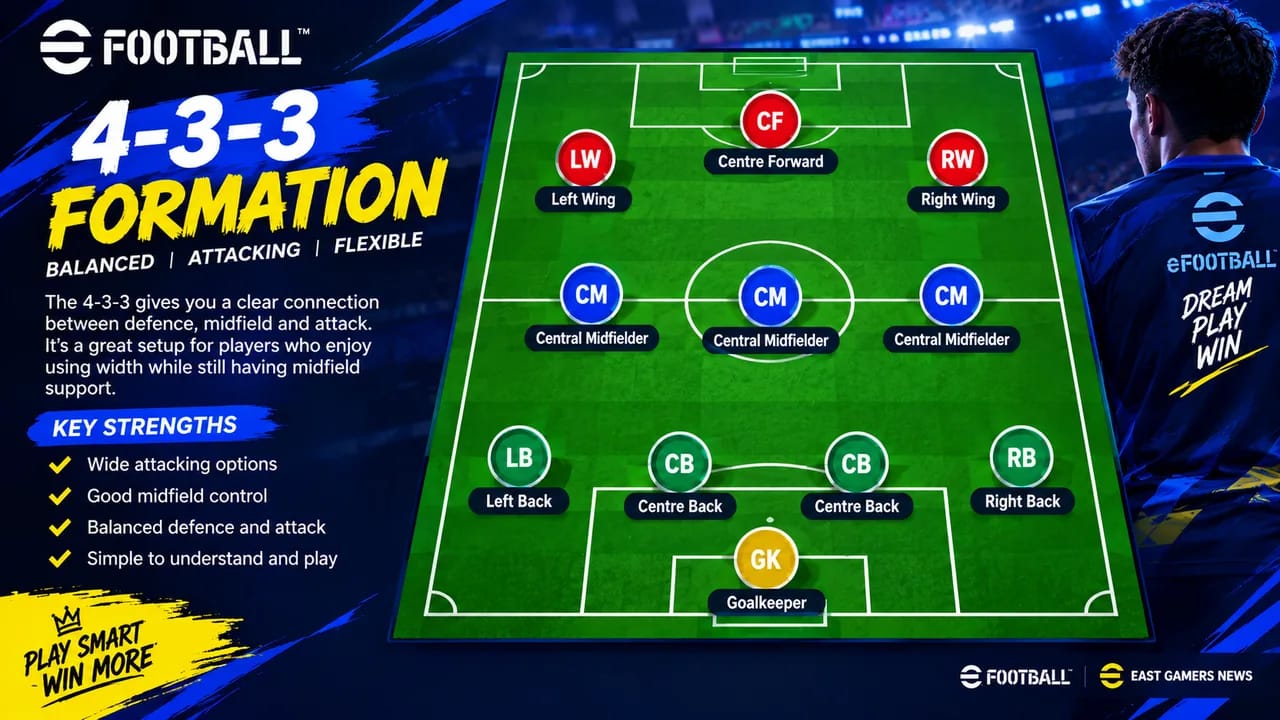
Among the best eFootball formations to start with, the 4-3-3 is one of the easiest to understand because it gives you a clear structure across the pitch. You have a back four, three midfielders and three attackers. That gives you a natural connection between defense, midfield and attack. For a player who likes using width while still having midfield support, it can be a useful starting point.
The key is not simply selecting 4-3-3 and expecting success. You still need to understand what happens when you lose possession. If your wide players push forward and your midfielders also move aggressively, space can appear behind them. That means your midfield and defense have to work together. The formation gives you the structure. Your decisions during the match determine whether that structure actually works.
ALSO READ: Sir Paul Foster Kenya Visit: GEF President Heads to Nairobi
4-2-3-1: More Protection Through the Middle
For players looking for the best eFootball formations with more protection through midfield, the 4-2-3-1 is a strong option.
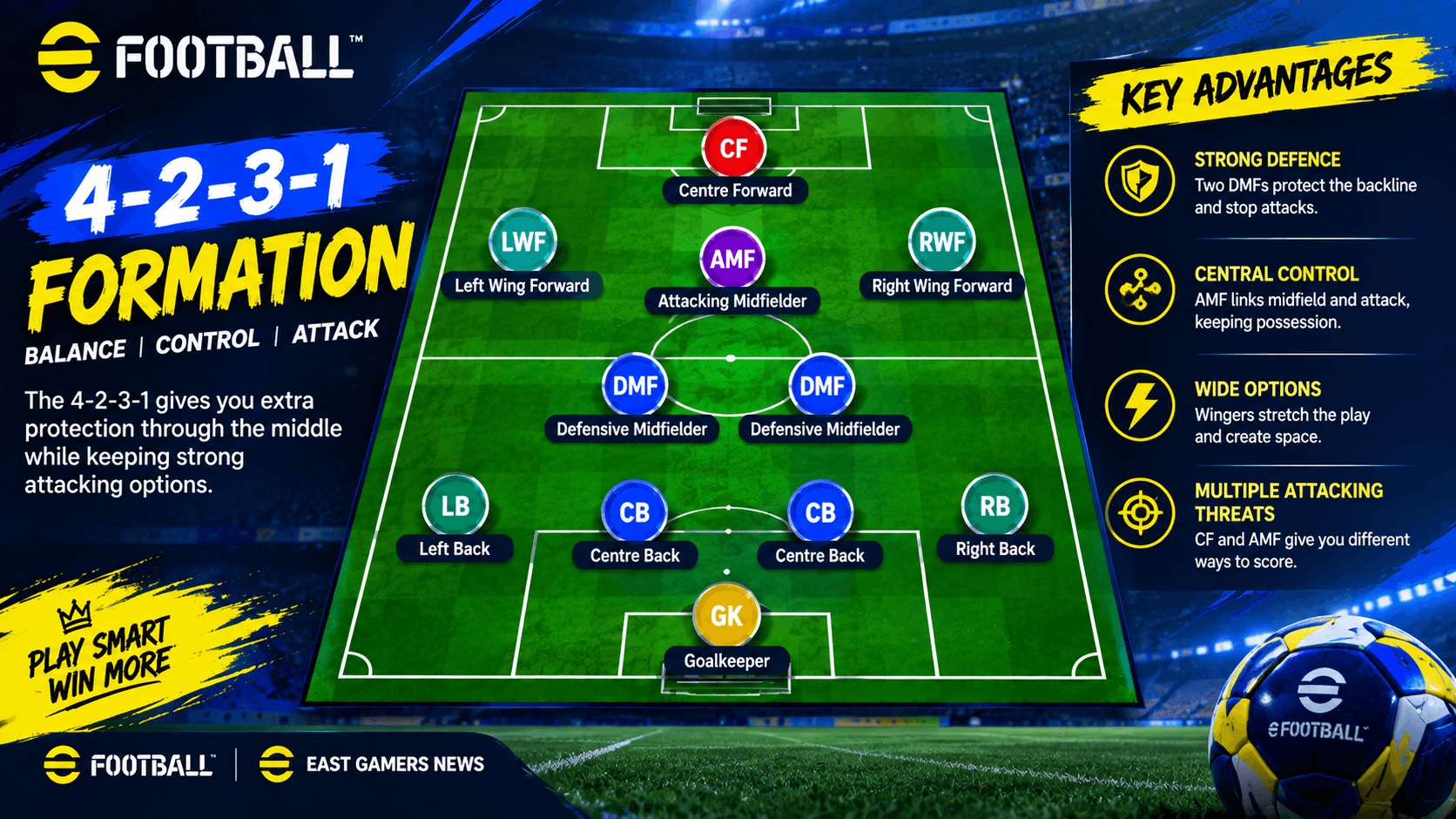
If you often find yourself conceding goals through the center, a formation with two deeper midfielders can give your team a different shape. The 4-2-3-1 provides a back four, two midfield players, three attacking midfield positions and one striker. It can be useful for players who want to maintain a stronger connection between midfield and defense while still having attacking support. The attacking midfielder can also become an important link between the midfield and striker.
If your attacking players become disconnected from the midfield, you may find yourself passing sideways without creating much danger. The solution is not always changing the formation. Sometimes you simply need to improve the movement and passing decisions within it.
4-2-1-3: Connecting Midfield to Attack
The 4-2-1-3 can also compete with the best eFootball formations when your main goal is creating more attacking options.
For players who enjoy having an attacking midfielder involved in the build-up, 4-2-1-3 is another shape worth experimenting with. The basic idea is straightforward: two deeper midfielders provide the base, an attacking midfielder operates ahead of them and three attackers stay higher up the pitch. This can create a clear route from the back into the attacking third.
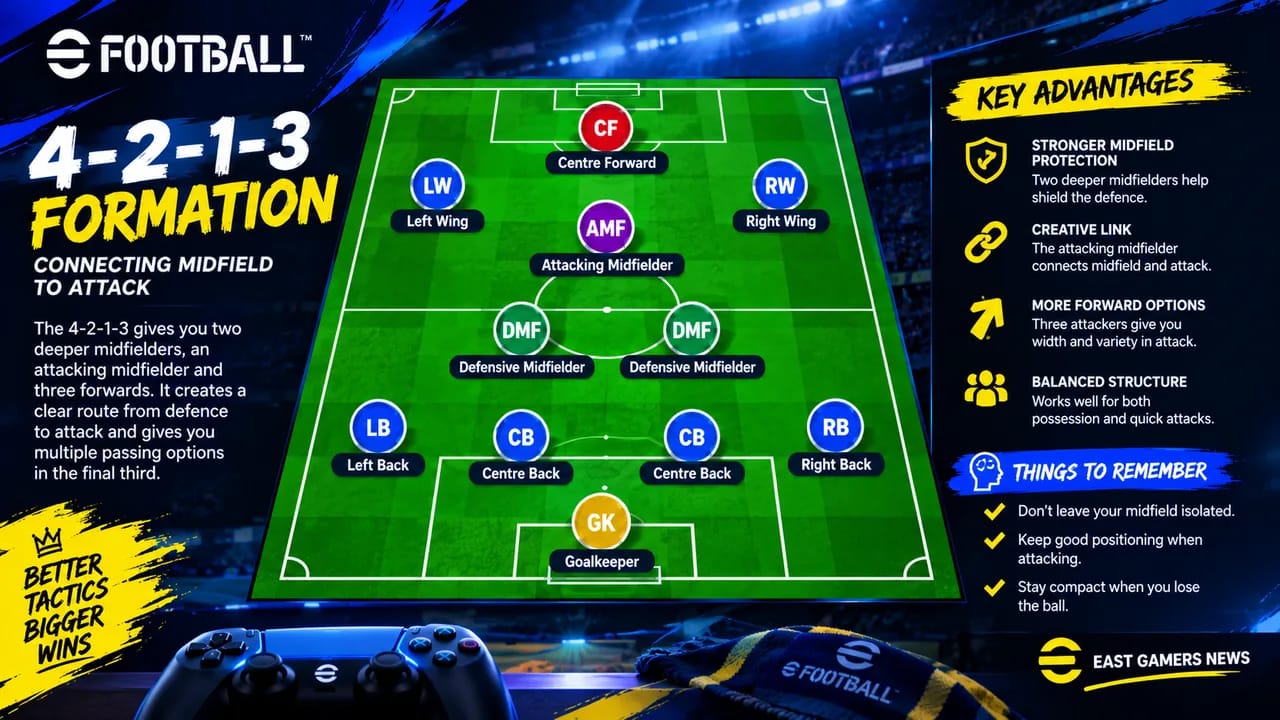
It also gives the player controlling the ball different passing levels. You can play into midfield, find the attacking midfielder and then look for the forwards.
The danger comes when too many players stay high. Lose possession at the wrong moment and your deeper midfielders may suddenly have too much space to cover. That is why formation selection and in-game discipline have to work together.
Don’t Change Formation Every Time You Lose
This might be one of the biggest mistakes players make. You lose a match and immediately decide: “This formation doesn’t work.” Then you change it. Lose again. Change it again. After a few matches, you have used five different formations without properly learning any of them.
Give your chosen formation time before deciding whether it belongs among the best eFootball formations for your style. Every setup has strengths and weaknesses. Your job is to understand those weaknesses and adjust your play. If you constantly change your shape, you never really learn where your passing options are, where your defenders tend to be positioned or how your attackers move. Mastery comes from repetition.
Why It Matters: Your Formation Should Make Your Decisions Easier
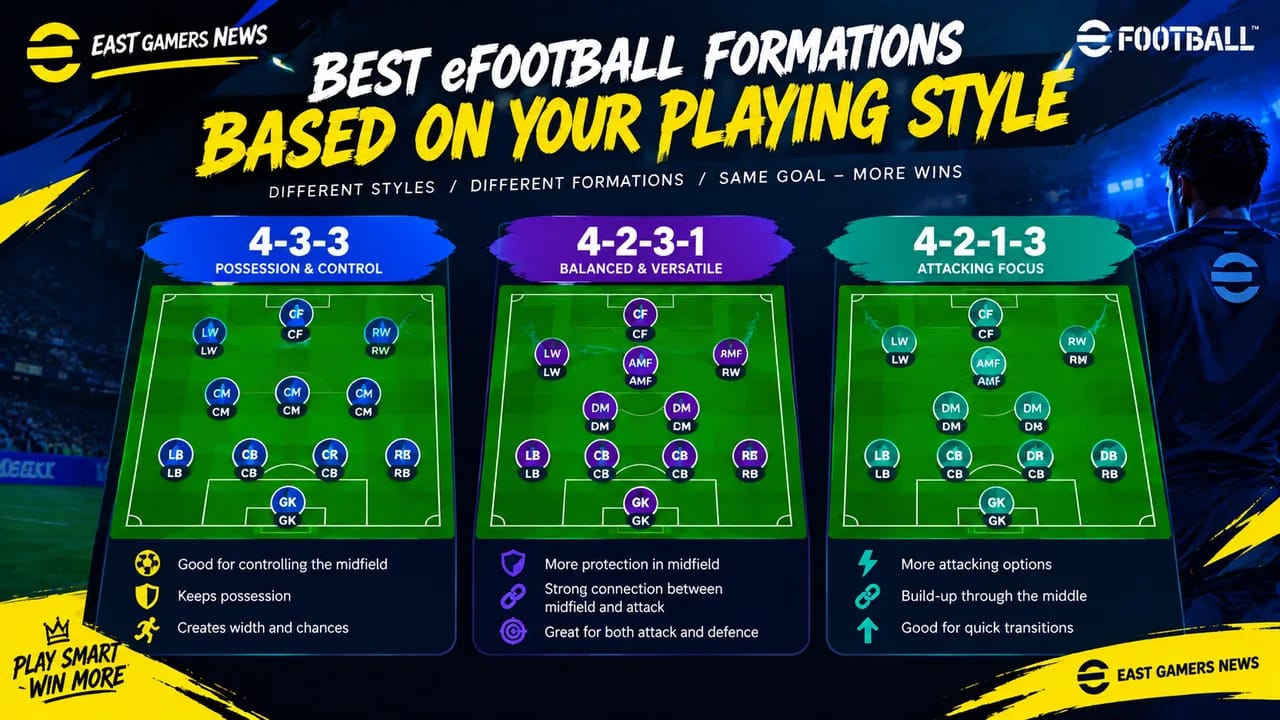
This is the part that often gets overlooked. A good formation is not simply about having the right numbers in each position. It should make your next decision easier.
When you receive the ball, you should have an idea of where the next passing option might be. When you lose possession, you should understand which areas need protection. When your opponent attacks down one side, you should know which players can provide cover.
That is why best eFootball formations are not necessarily the formations with the most attacking players. They are formations that give you a structure you understand. Once you understand that structure, you can start making better decisions under pressure.
Test Your Formation Like a Real Match
Remember, even the best eFootball formations will not work instantly if you have not learned how your players move within the shape. Don’t judge a formation after five minutes Play several matches with the same setup. Pay attention to three things:
1. Where are you losing the ball?
If you repeatedly lose possession in the same area, your formation or your decision-making may be creating a problem.
2. Where is your opponent finding space?
If opponents constantly attack the same area, look at which players are leaving that space open.
3. Are your attackers receiving the ball?
A formation may look attacking on paper, but if your forwards are rarely getting useful passes, something needs to change. This approach is much better than simply asking which formation is best. You are studying your own game.
Make Small Changes Before Making Big Ones
E Football is regularly updated, so your formation choices should not be based only on old tactics. You don’t always need to complehttps://www.konami.com/tely rebuild your team. Sometimes a small adjustment can change how your team feels. Move a player into a more suitable position.
Change who starts in midfield. Try a different striker. Give your attack more width. Protect the center more carefully. The goal is to find a balance between your players and the shape you want to play. Think of it like building a football team in real life. You don’t buy 11 talented players and simply put them on the pitch. You need roles. You need balance. You need players who understand what the team is trying to do.
Learn Your Formation Before Blaming Your Players
There will be matches where nothing works. Your passes feel slow. Your opponent presses aggressively. Your striker cannot find space. Your midfield feels invisible. That does not automatically mean your squad is bad. Sometimes you are simply asking your players to do things that your formation does not support.
The best response is to slow down and identify the actual problem. Are you lacking midfield options? Are your forwards too isolated? Are your fullbacks leaving too much space? Are you trying to attack too quickly? Once you identify the problem, your next change becomes much more meaningful.
The Best eFootball Formations Are the Ones You Understand
There is a temptation in eFootball to search for one secret formation that will suddenly transform your results. It doesn’t work that way The formation is only the starting point. Your player selection, movement, passing, defending and decision-making all matter. That is why best eFootball formations should be viewed as tools rather than guaranteed winning formulas.
A formation that works brilliantly for one player might feel completely wrong for another. If you love controlling possession, build around that. If you prefer quick attacks, give yourself the structure to attack quickly. If you struggle defensively, don’t be afraid to sacrifice some attacking freedom for greater balance.The important thing is knowing why you are using a particular shape.
Final Thoughts
Choosing the best eFootball formations is really about understanding your own game. Don’t copy a formation simply because another player is winning with it.
Look at your squad. Look at your preferred style. Look at where your team is strongest and where it keeps getting exposed. Then choose a formation that brings those strengths together.Once you find a shape that feels natural, stick with it long enough to actually learn it. Understand the passing lanes. Learn where your players appear during attacks. Notice where gaps open when possession is lost.
That is when a formation stops being a collection of positions and starts becoming your way of playing. When that happens, every match becomes easier to read. You stop reacting to the game.You start controlling it.
PEOPLE ALSO ASK (FAQS)
What is the best 4-3-3 formation in eFootball?
The best 4-3-3 formation in eFootball uses a standard flat 4-3-3 with one Defensive Midfielder (DMF) and two Central Midfielders (CMF), paired with the Quick Counter or Long Ball Counter playstyle
How to beat 4-2-1-3 formation in eFootball?
To beat the 4-2-1-3 formation in eFootball, you need to overrun their central midfield and lock down your fullbacks to stop their quick counter-attacks
Is 4 2 2 2 a good formation?
The 4-2-2-2 formation is a strong, highly compact setup that excels at central control, quick counter-attacks, and defensive stability, though it lacks natural width
Which formation is better, 3-4-3 or 4-3-3?
The 3-4-3 formation prioritizes attacking overload with three central defenders and aggressive wing-backs, while the 4-3-3 offers greater structural balance and defensive stability through a traditional back four.